




Engineering Precision in Brake Pad Production: How Infrared Halogen Heaters Deliver Dimensional Stability
When we’re sizing up heating for a brake pad line, it’s pretty straightforward. We need to hit temperature fast, keep it rock steady, and stop warping and spring-back from eating into your yield. That’s why we built our infrared halogen heaters to tackle the real headache: thermal stress and parts that just won’t hold their shape.
Power, Voltage, and Geometry—Why It All Matters
We run these heaters on 400V, which is a smart fit for most plant power setups. It gives you the current you need to ramp up quickly, without pushing the wiring past its limits. Then we pair that with a 300mm tube and 2500W of power. That combo packs a lot of heat right where the brake pad material needs it. This isn’t about overpowering the part. It’s about matching the heater’s output to the thermal mass of what you’re curing. And the geometry matters. The 300mm tube gives you a clean, precise heating footprint. So you can zone your line with real control and make sure every pad gets the same thermal treatment. That’s how you get results you can count on, shift after shift.
Material and Design: Halogen, Coating, and Connectors
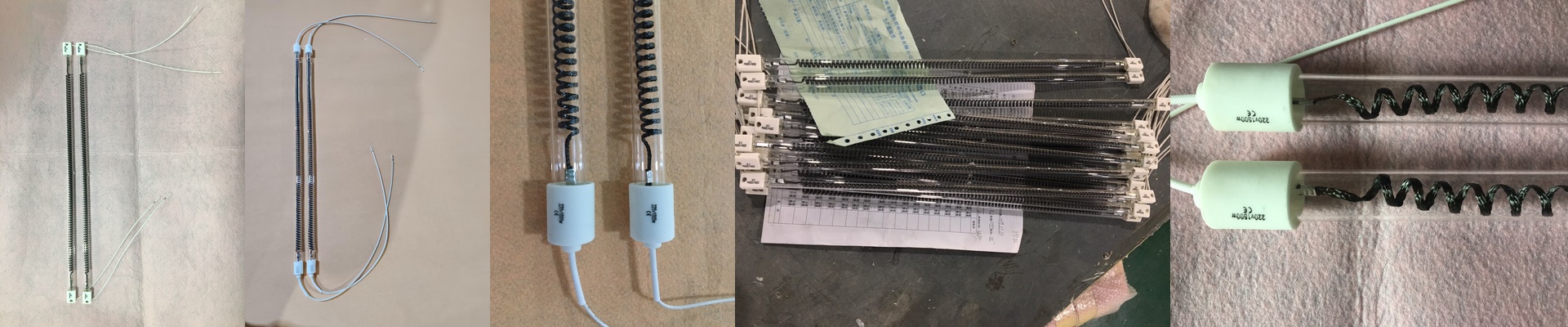
We put halogen elements inside a quartz tube for one big reason: response time. The halogen throws intense, focused infrared energy that gets into the friction material fast. That cuts down soak time, and less soak means less stress building up. Meanwhile, the quartz envelope takes the thermal shock of rapid on/off cycling without cracking. The tube also has a specialized coating to manage emissivity and stand up to the chemical grit of a production line. It keeps the surface consistent and clean, so the heat output stays stable over the life of the heater. For the electrical side, we use R7s or SK15 connectors. These weren’t chosen at random. They’re compact, tough, and built to handle high heat right at the heater. You get a secure, low-resistance connection that won’t loosen under vibration, and when it’s time for maintenance, the heater swaps in like a simple drop-in.
On the Line: Less Stress, Better Dimensions
Out on the brake pad line, uneven heating is the real villain. When the heat profile is off, the binder resins cure unevenly, and the pad warps. Our infrared heaters bring focused output and zone control to the table, so you get even heat across the surface. That uniform energy removes internal stress, and the part cures without twisting. The payoff is dimensional stability. Parts hold their shape, so you see less scrap and fewer reworks. And because the heaters respond quickly, you also trim cycle time and boost overall line throughput. One practical heads-up: a 2500W heater puts out serious localized heat. Make sure your machine’s cooling and ventilation are set up to handle the temperature rise. Plan for that, and you’ve got a reliable, high-output thermal solution that keeps your line moving.