

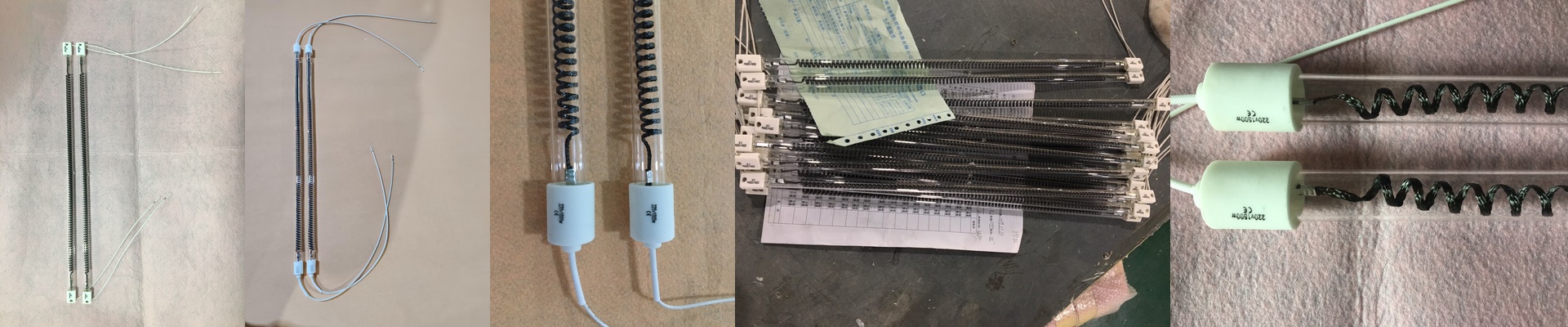


Let’s talk about the Carbon fiber infrared heater.
We built these things for the real world—the kind of industrial work where you need heat, and you need it fast. Forget those old quartz lamps. We’re talking about a carbon fiber filament, tucked away in a vacuum or gas-filled tube, often with halogen tech to keep it running strong. It’s all about getting that heat exactly where you want it, right when you need it.
The nuts and bolts: Power, voltage, and size.
These heaters are all about the details. Picture a unit that runs on 400V and packs a 2500W punch, all in a slim 300mm tube. That’s a lot of power in a small space. It’s what makes spot heating possible, or getting a machine up to temperature in no time flat—think PET blowing or plastic forming. The 400V rating is a smart choice, too. It matches up with industrial power supplies, which means you pull less current and can run longer cables without worrying about voltage drop. But here’s the catch: that much power in one spot generates serious heat. You absolutely need to manage it. Proper airflow or cooling is non-negotiable if you want to protect the components nearby.
What’s inside? Halogen, coating, and the right connections.
There’s some clever stuff going on inside that tube. The halogen cycle is working overtime, redepositing any evaporated material back onto the filament. It keeps the filament clean, which means the output stays steady and the whole thing lasts way longer. The quartz envelope itself often has a special coating, too. This lets you fine-tune the infrared spectrum, focusing the energy in the shortwave or medium-wave bands. The result? Better absorption, especially for specific materials. And the connector? That matters more than you’d think. The R7s base is a standard double-ended fitting. It makes installation a breeze and ensures a rock-solid connection, even with the high current and constant vibration. It’s designed to be a simple, drop-in replacement for what you already have.
Where it shines and what it means for you.
On a production line, like when you’re blowing PET, you need heat that’s fast and even. That’s exactly what these carbon fiber heaters deliver. The response is almost instant, and the control is precise. Their compact size is a huge plus when you’re working in a tight spot, and the R7s connection means maintenance happens in a flash. You get speed and intensity, no question. But you have to balance that with the right cooling and a solid electrical setup. For the engineers out there, it just means things run predictably, integration is easier, and you spend less time down because a lamp needs changing.